


Mr. Paul Neuray starts the chapter on Stanleyville (currently: Kisangani) with a statement that the city’s nickname “Stan” was more popular than its proper name. Stanleyville was the capital of the eastern province. Mr. Neuray describes it as “worthy of its great governors” and “ready to grow even bigger”. However, he notes that the expedition found “Stan” in the state of stagnancy caused by a crisis and by administrative reorganization. The sights described in the article include well-defined avenues, charming villas with gardens full of flowers, cemented tennis courts becoming noisy just after the end of the excessive heat and a cannon of a great caliber which was a war trophy from the battle of Tabora. Among the signs of crisis one could notice smaller number of customers in luxury stores and an empty high-class hotel. The sweet and sour landscape is completed by a picture of a lumberjack from Ardennes holding his axe next to a wild boar.
According to Mr. Neuray, the river Congo seemed to be particularly impressive near Stanleyville. The expedition members could see a stone stele dedicated to the memory of lieutenant Dubois who died in that place on the 26th of August 1886. It inspired a mention about a Scottish officer, Mr. Walter Deane who “had really tried to save” Mr. Dubois.
Mr. Neuray dedicates some paragraphs to the market of “Stan”- filled by a noisy crowd looking at “all containers of the world”- from a bowl made of dried soil to an ornate basin. The products could be described as countless and hard to describe, bargains- as extreme. Mr. Neuray noticed large amounts of salt, some elegant people walking around and a stolid police agent waiting for a moment when his intervention would be needed.
In an Arab village nearby Mr. Neuray noticed people wearing white, thin houppelandes, lingering on the doorsteps of comfortable huts. The leader lived in a two-story house. A tricolor flag hovered in its window.
As the expedition moved closer to the Wagenia Falls, the river Congo seemed to foam and roar harder. On its banks and in the center of its riverbed there were scaffolds made of barely squared logs.
An excited crowd surrounded a place where the canoes were launched. The Wagenias of Binakulu would reveal their fish traps and Messrs. Dekeukeleire and Rents were ready to document that. At first, things were happening slowly, with canoes approaching the middle of the river. The movement of the paddles accelerated. The current of the river required “a superhuman effort”. Mr. Neuray states that initially the canoeists “fought and won”. Then the water became stronger and carried them away. Tireless, they went back upstream. The river seemed even more dangerous as it was fringed with foam. However, the Wagenias reached their destination. Having been already impressed by the strength of the indigenous people, the expedition members saw some other fishers jumping into the water and overcoming the power of the current with a flawless crawl to retrieve the fish traps. A triumphant reveal of a “kisengesenge” (a fish called “captain”) was the climax of the scene. Mr. Neuray describes the “captain” as an animal with a dreadful jaw which should strike terror to smaller organisms.
The action-packed story about the fights against the river is followed by a paragraph about the chants of the fishers. The journalist describes the initial sound as “monotonous chant that could pinch one’s innards”. “Then, the voices swelled into a vigorous crescendo”- he adds. As the tone got lower, the journalist got an impression of hearing a prayer to the deities of the river. He describes the chant as a homage to the life-giving water.
Then, he proceeds to sounds and smells of nature itself. From the sound of thunder to the clouds of foam, probably of the Tshopo falls. The river Tshopo is a tributary of the river Congo. Mr. Neuray describes the Tshopo falls as “captivating spectacle”. “No indigenous people, just nature”- he adds. “Contemplating a mass of water which was falling to dust at their feet” took the expedition members some hours. They found the view really beautiful.
Then, they went on from watching nature to experiencing civilization as Stanleyville was the center of Congolese education. A professional school created by Marist brothers was shown to them by a proud missionary. Mr. Neuray describes the visit as too brief, yet showing what can be achieved by people who work with energy and dedication.
A cathedral, placed on top of high stairs, was dominating a valley bordered by palm trees “erected like masts”. Mr. Neuray claims having seen “proofs of Belgian colonial virtues” at every step. He adds that Stanleyville had asked for nothing but development and that the city’s full growth was stopped by the crisis. Yet, the expectations kept being high.
Mr. Neuray illustrates that with a scene in “a model hospital” to which the rescuers brought an indigenous person with wounds caused by members of a secret society called Anyoto. Anyoto who are known as “leopard men” were attacking people to murder them and leave traces which would give the impression of a leopard attack. The victim seen by the expedition members was almost bled dry. Mr. Neuray was convinced that the person would die the next day.
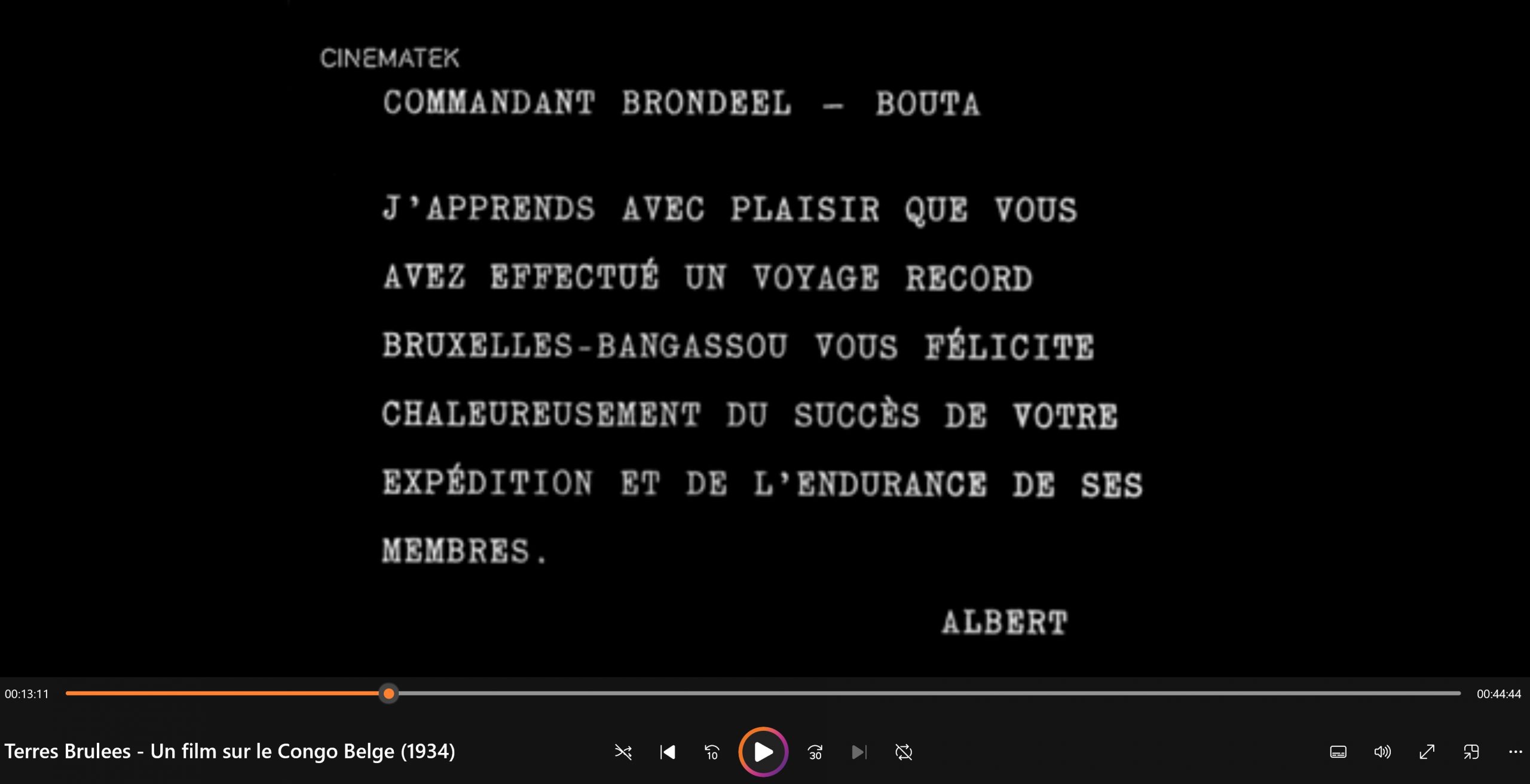
On the 13th of February the Expedition members received a telegram from the King Albert.
The correspondence was as follows:
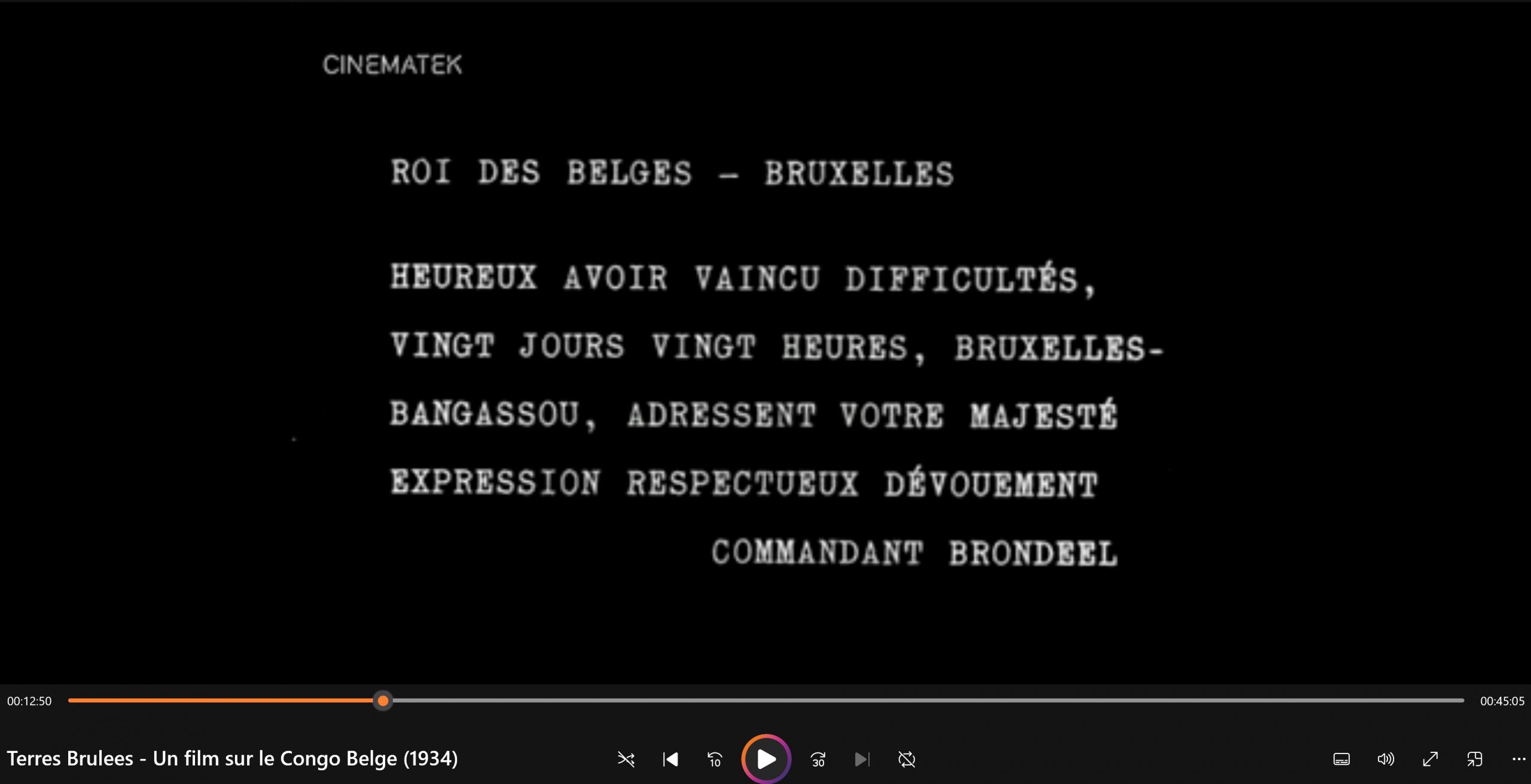
Four days later the king died, but Mr. Brondeel and his colleagues learned about that after a week.
Andrzej Szczodrak
Many thanks to:
Uwe, Ante and Valentin
Mrs. Viviane De Jaeger
Mr. Jean-Luc Ernst
The Goyvaerts family
Mr. Marc Duhoux
Mr. Michel Jacquemart, Dr. Pierre Jacquemart
Mr. Marc René Crahay
Mr. Rob Van den Broeck
Mrs. Françoise Quatrus
Mr. Paul Grant